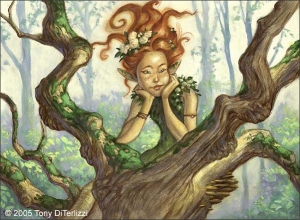
 A while back, Yan and I designed a new D&D core class based on the Monster Manual’s Pixie and Monte Cook’s variant Sorcerer (from the Complete book of Eldritch Might, or CBoEM) called the Shaper.
Yan has been using/playtesting it for the last 6 or 7 sessions in our game. For reasons I explained yesterday, he wishes to move on from it.
I asked him if he could write a short postmortem about the class’ playability and design issues. He gracefully agreed.
I’m posting them here with my own thoughts on it in italics.
What was the motivation for the class?
The Shaper class was created as a fey arcane caster because none of the core class really had the feel of a fey magic user. (ChattyDM: and we do not like prestige classes)
Sorcerers do not have enough nature-flavored magic and druids felt too much like a religious type. I wanted a fey sorcerer that felt like one.
Both Phil and I have been heavily influenced by the book Jonathan Strange & Mr Norrell, written by Susanna Clarke (ChattyDM: an excellent, albeit very slow novel). This book has inspired our perception of the fey.
The shaper was an attempt to tap in the magical essence of these creature and give them something more appropriate.
Did the class’ crunch deliver as intended?
As a matter of fact, it did. By giving access to druidic magic and banning any fire or necromantic spell, I really ended up with something that truly felt like fey magic.
Chatty DM: It was very interesting to see the character go. Slow spells added a great flexibility to the character without actually breaking anything. Lesser Restorations, Call Lightning, Combat buffs were all very useful! And the classes fluff was perfect!
What was changed during playtesting?
The slow spell where adjusted a few sessions after introducing the charcater.
Chatty DM: Reminder Slow Spells are spells taken from a larger spell list (that includes Bardic and Druidic spells) but that originally took 4 times longed to cast an took only 1/2 spell slot.
As we where play testing them, we noticed that the slow spells had no large impact in combat and had a considerable one outside of it. It was giving almost free access to healing spells and the like (lesser restoration in our case).
This was not supposed to be a cleric substitute and was not meant to outshine them. (Chatty DM: Not that it’s a hard thing to do this late in the 3.5 design cycle)
We wanted to have an interesting tension between the use of slow spells versus normal ones.
We then changed the way slow spell worked. We reduced casting time to twice the usual casting time and removed the half slot cost to a single free use of these spells per spell level.
This gave a good tension between wanting to use a spell in a fight as they became full round spell while basically removing the impression of abuse that the half cost gave us.
What are the strong and weak point of the class?
Being an invisible, flying, spell caster is powerful.
This class is the perfect support class you can be anywhere on the battle field ditching help where needed the most. This comes at a cost though, you won’t have the iconic fireball spell which is one of the best spell in the sorcerer list and your access to spell is slower.
ChattyDM: I’ll also add that the Pixie remains a glass canon, especially since SR and DR only appear passed the mid-point of the class progression. I think that the levels before the sweet spot (less than 4) are hard for the player that basically plays an invisible miniature archer.
What role does it fill in a group and what type of player should consider it?
Like I said this is more of a versatile support class. The thing is, unless an opponent can see invisible creatures, you are free to do whatever you want. This will please and infuriate at the same time the brilliant tactician (See article here
for definition of player types) as they will like the opportunity to be anywhere but will hate the lack of challenge.
Butt kickers will hate this class as it lacks the signature area effect spell that is Fireball and is totally inefficient as a melee class. Casual player may love it, as the battle field mechanic becomes irrelevant and they will be able to support their buddies. (Chatty DM: However the player must juggle two independent spell systems)
The storyteller/method actor shouldn’t care as this class is as good as any to weave a story…
Chatty DM: Although it offers storytellers and psychodramatists a rare window in playing a fey character in pre 4e D&D. Specialists that go for flying elf types would be served by the concept.
Summary of Liliee’s key statistics
10th level Shaper
Str:4, Dex:23, Con:12, Int:18, Wis:12, Cha:27 AC:19, Fort:5, Refl:10 Will:15
Racial/class ability: Low-light vision, natural invisibility (Improved, Free action)
Feats: Spell penetration, Greater Spell penetration, Force of personality (Complete Adventurer), Precise Shot (for ranged touch spells…)
Key Spell:
Level 1 spell: Silent Sound (most frequently used spell), Alter self, Mage armor, Fey storage(Complete book of Eldritch Might, a 25 hour mini bag of holding. Really useful given the Str score)
Slow spell for 1st level: Charm animal, Speak with animals
Level 2 spell: Glitter dust (CBoEM, Blinds mooks and dispels invisibility, Quite usefull), Pierce( CBoEM, Shatters protective Force effects + damage, Great to beat arcane casters behind heavy protection magic), Shrapnel Globe (CBoEM, Full round casting, 5d6 max non elemental damage spell, most useless spell was about to change it)
Slow spell for 2nd level: Barkskin, Lesser restoration
Level 3 spell:Protection from energy, Force blast (CBoEM, Line of force area damage spell, her one and only area damage spell although a good one)
Slow spell for 3rd level: Call lightning, Quench (Puts out fire, total fluff pick)
Slow spell for 4th level:Gird the warrior (CBoEM, A very powerful armour buff, Your group tank will love you 😉
Key Skill: Maxed out Use Magical Device which was impressive with the high charisma. Thus giving access to basically any spell in a wand.
Key Equipment gave the following bonus: +1AC, +2dex, +2cha and +1 to all save
Conclusions:
The Shaper is a great class for support players that can stand in as a healer if a campaign features standard Magic Item levels. Stock up on wands and go wild.
It does feature an apparently sucky early progression we haven’t tested though. It should need to be reworked.
We had a lot of fun with it. If ever someone else tries it, let us know.
We might try to adapt it to 4e next year, who knows…
Looks good, i like reading custom classes like this that don’t tread on pun pun territory.
When i think fey i think Jarod from the labyrinth more than small invisible fairies, especially with a name like shaper but i can see how you could pull off some good role play with a character like this.
One question, how did you RP her joining the party. I can’t imagine that this race spends much time in a tavern.
One of Yan’s main character goals was to play a Fey that was fascinated with humanoid cities and civilizations and that had at the same time shunned her own origins.
She was originally slated to be the priestess of her noble house’s patron goddess and she fled that.
Yan played her as an attention starved ‘I want to fit in real bad’ character.
She basically joined the group by staying invisible close to the original members and playing her flute long enough to become a de facto member.
I do have a page long background story for the character… 😉
She was an awesome flute player, the high charisma combined with a maximized performance skill.
They say music is universal and it was her initial approach to fit in. Which evolved later on into the alter self spell…
Yeah that Sex scene with you as a Nymph and Cruger was….
Oh… it never happened?
Huh, move along, nothing to see here…
From a DM’s perspective, how did having a nigh-perfect infiltrator on the team affect the way adventures played out?
Did your rogue/stealth oriented characters feel superfluous at all?
Excellent question….
Having a scout helped the players a lot in planning for the unexpected. All encounters that weren’t behind closed doors were tackled with a prepared party, which I didn’t mind.
So in that she fit the role perfectly.
We had no other stealthy PCs so no stepping on toes.
As for the pace of the game it was state that Lillie was always scouting head.
So basically Phil made the battle setup told us what Lillie saw, we made our plan and the fight started.
Having no cleric in the group the plan ahead capability was a boon. Highlighted by the two ambushes we had, both of which nearly ended up in a party wipe.
I’m not looking to re-open any wounds, but Phil accidentally found a way to disable that pixie scout. However, it was discovered that this realization couldn’t be used as a solution. Like mentioned before, she really was a glass cannon. If she’s visible and/or immobile, she’s about as troublesome as a common fly.
First game aside (with the 30ft reach grapple, magic immune, seing invisble hound) Lillie was never truly in danger she could always just fly away.
Her firepower was below the rest of the group therefore was less of threat although she always manage to be where it count.
Iiiinteresting. I had a player in a 2e game play a pixie out of the complete book of humanoids back in the day. That sleep poisoned bow made low-level adventures almost pointless – nothing has resistance, nothing can see invisible pixies floating around up in the sky.
We nixed the sleep arrows and we also never used Otto’s Irresistible dance!
🙂